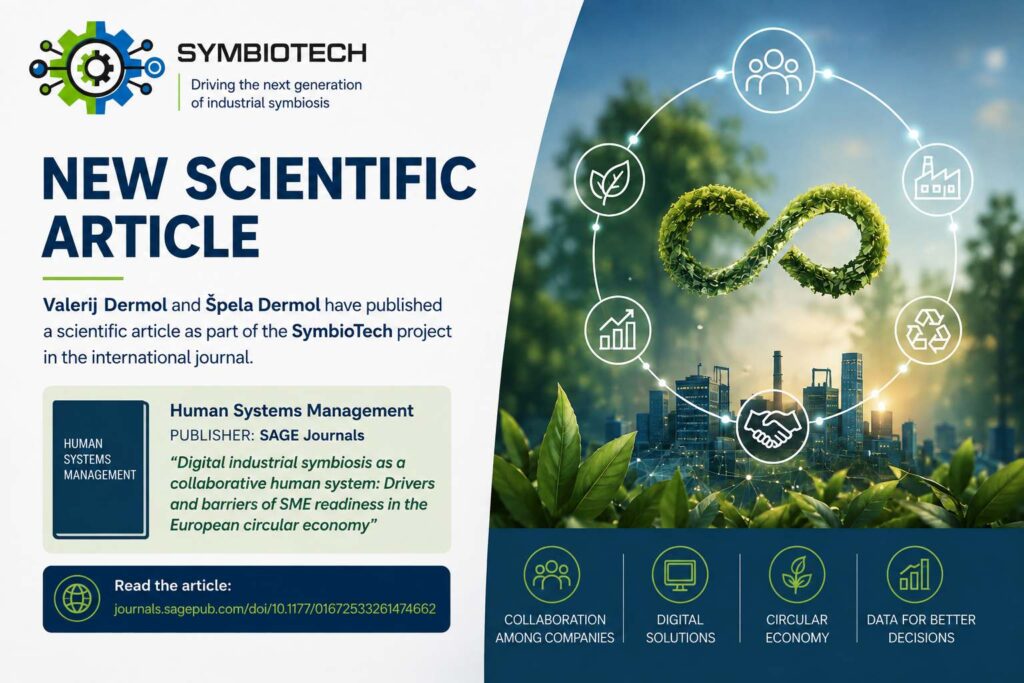
As part of the SymbioTech project, Valerij Dermol and Špela Dermol have published a new scientific article entitled “Digital industrial symbiosis as a collaborative human system: Drivers and barriers of SME readiness in the European circular economy.”
The article was published in the international scientific journal Human Systems Management, published by SAGE Journals.
How ready are SMEs for digital industrial symbiosis?
Industrial symbiosis is based on collaboration between companies, where materials, resources, energy, by-products or knowledge from one company can become valuable inputs for another. With the support of digital technologies, new opportunities are emerging for connecting companies, exchanging data and identifying potential synergies more efficiently.
However, technology alone is not enough.
In their article, the authors explore how ready small and medium-sized enterprises (SMEs) are to engage in industrial and digital industrial symbiosis, as well as the factors that encourage or hinder their participation.
The research combines qualitative and quantitative data gathered from SMEs and intermediary organisations across several European countries. Particular attention is given to companies’ digital maturity, perceived benefits and barriers, and the support provided by their wider business environment.
Digital maturity and perceived benefits matter
The findings show that digital maturity and the benefits companies recognise in such collaboration are among the key factors influencing SMEs’ readiness to participate in digital industrial symbiosis.
At the same time, the study highlights an important distinction between a company’s willingness to participate and its actual ability to put such collaboration into practice. Barriers and institutional support therefore play an important role in determining whether industrial symbiosis can move from intention to implementation.
These findings are relevant not only for SMEs, but also for intermediary organisations supporting industrial symbiosis, policymakers, and developers of digital platforms and other support solutions.
The research forms part of the broader activities of the SymbioTech project, which aims to support industrial symbiosis, digital collaboration and the transition towards a more circular economy.
Read the article on SAGE Journals:
https://journals.sagepub.com/doi/10.1177/01672533261474662